A Comparison Guide Between GB WhatsApp & Official WhatsApp

The messaging application landscape has evolved dramatically over the past decade, with WhatsApp emerging as the dominant global platform connecting billions of users across diverse demographics and geographic boundaries. However, the official WhatsApp experience, while robust and secure, hasn’t satisfied every user’s desire for customization, privacy control, and advanced functionality. This dissatisfaction gave rise to modified versions, with GB WhatsApp 2026 standing as the most prominent alternative, attracting millions of users seeking features that the official platform deliberately restricts.

This comprehensive comparison examines every facet of both applications, providing detailed analysis of their respective strengths, limitations, security profiles, and suitability for different user needs. Whether you’re considering transitioning to GB WhatsApp, evaluating whether to remain with the official platform, or simply curious about the differences between these messaging experiences, this guide delivers the thorough, unbiased information necessary for informed decision-making.

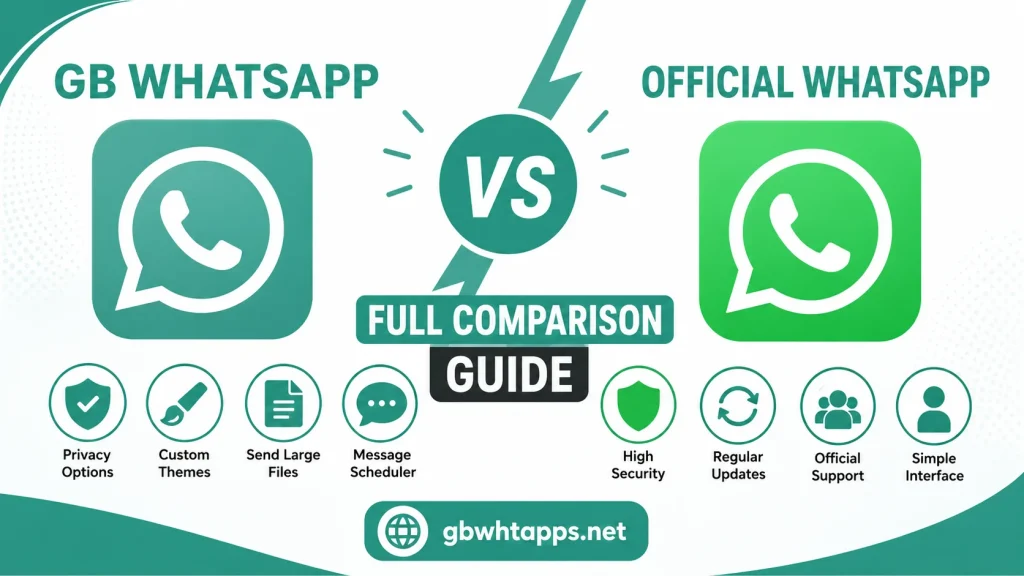
GB WhatsApp vs WhatsApp (Official)

Understanding the Fundamental Differences

Before diving into specific feature comparisons, understanding the foundational distinctions between these applications clarifies why such significant functional differences exist and persist despite official platform evolution.

Development Philosophy and Origins

Official WhatsApp represents a corporate product developed by WhatsApp Inc., subsequently acquired by Meta Platforms (formerly Facebook). Its development prioritizes mass-market accessibility, regulatory compliance, business integration, and ecosystem consistency across global markets. Every feature undergoes extensive testing, legal review, and strategic alignment with Meta’s broader platform objectives.

GB WhatsApp emerges from independent developer communities operating without corporate oversight or strategic platform constraints. This independence enables rapid feature implementation responding directly to user requests, unencumbered by business model considerations, advertising integration concerns, or ecosystem lock-in strategies. The modification philosophy centers on user empowerment and feature maximization rather than market expansion or revenue generation.

Distribution and Installation Models

Official WhatsApp distributes exclusively through sanctioned app stores—Google Play Store for Android and Apple App Store for iOS. This distribution ensures automatic updates, verified code integrity, and seamless integration with device operating systems. Installation requires minimal technical knowledge, with the application becoming immediately available through standard platform search and installation procedures.

GB WhatsApp requires manual APK installation from third-party sources, bypassing official app store verification and distribution channels. This sideloading requirement creates initial barriers to entry, demands user technical engagement, and establishes ongoing update responsibilities falling entirely on users rather than automated systems. The trade-off accepts installation complexity in exchange for access to unauthorized features.

Legal and Policy Frameworks

Official WhatsApp operates within established terms of service, privacy policies, and regulatory frameworks governing data handling, encryption standards, and user rights. These frameworks, while sometimes restrictive, provide legal recourse, accountability mechanisms, and predictable operational boundaries. Users engage with documented rights and responsibilities, supported by corporate customer service infrastructure.

GB WhatsApp exists in policy gray areas, explicitly violating WhatsApp’s terms of service while operating in legal ambiguity regarding software modification and distribution. Users gain enhanced functionality without corresponding legal protections or formal support channels, accepting enforcement risks including potential account suspension in exchange for feature benefits.

Comprehensive Feature Comparison

The following detailed comparison table presents key differences across essential messaging dimensions, followed by in-depth analysis of each category.

Feature Category

Official WhatsApp

GB WhatsApp

Advantage

Privacy Controls

Basic read receipt toggles, limited status privacy

Granular blue tick control, online status hiding, typing indicator suppression, anti-revoke messages

GB WhatsApp

Customization Options

Fixed themes, limited chat backgrounds

4000+ themes, custom fonts, color scheme modification, layout personalization

GB WhatsApp

Media Sharing

16MB file limit, reduced quality compression

50MB+ file sharing, original quality preservation, enhanced format support

GB WhatsApp

Message Management

Basic deletion, 1-hour edit window

Anti-delete messages, scheduled messaging, auto-reply functionality, bulk messaging

GB WhatsApp

Security Architecture

End-to-end encryption, verified code base

Same encryption base, unverified modifications, potential vulnerability introduction

Official WhatsApp

Account Safety

Full terms compliance, no ban risk

Terms violation, periodic ban waves, account recovery uncertainty

Official WhatsApp

Update Reliability

Automatic, immediate security patches

Manual, community-dependent, potential delay vulnerabilities

Official WhatsApp

Multi-Account Support

Single account per device, business separation only

Dual/triple account operation on single device

GB WhatsApp

Interface Features

Standard navigation, fixed layout

Customizable home screen, hidden chat sections, extended status duration

GB WhatsApp

Backup Integration

Google Drive seamless integration, iCloud for iOS

Local backup focus, manual transfer requirements, cloud limitations

Official WhatsApp

Performance Optimization

Standard resource usage, battery optimization

Enhanced compression, data saving modes, performance tuning options

GB WhatsApp

Platform Stability

Consistent operation, crash resilience

Variable stability, version-dependent performance, occasional conflicts

Official WhatsApp

Customer Support

In-app support, help center, community forums

Community-dependent assistance, no formal support channels

Official WhatsApp

Cross-Platform Sync

Web, desktop, tablet synchronization

Android-focused, limited cross-platform functionality

Official WhatsApp

Deep Dive: Privacy and Security Analysis

Privacy represents the most significant differentiator between these platforms, warranting detailed examination beyond the comparison table overview.

Official WhatsApp Privacy Architecture

The official platform implements privacy through several interconnected mechanisms. End-to-end encryption applies universally to all messages, calls, and media, ensuring that only conversation participants can access content. WhatsApp cannot decrypt message contents even if legally compelled. Privacy settings allow users to control last seen visibility, profile photo sharing, about information display, and status audience selection.

However, official privacy controls maintain significant limitations. The binary read receipt toggle disables read receipts entirely or enables them universally—there’s no granular control for specific contacts or conditional display. Online status remains visible whenever the application is active, creating availability pressure. Typing indicators and recording status provide real-time activity information that some users find intrusive.

Metadata collection presents additional privacy considerations. While message contents remain encrypted, WhatsApp collects and stores information about who communicates with whom, when communications occur, device information, and usage patterns. This metadata supports business model development and potentially enables sophisticated traffic analysis despite content encryption.

GB WhatsApp Privacy Enhancements

GB WhatsApp transforms privacy from binary options into granular, user-controlled configurations. The platform’s signature feature—blue tick management—exemplifies this philosophy. Users can hide blue ticks universally, enable them for specific contacts only, or configure conditional display showing read receipts only after responding. This granularity extends to double ticks, allowing users to appear offline even when messages have been delivered.

Online status hiding enables application usage without broadcasting availability, eliminating the pressure of immediate response expectations. Typing indicator suppression allows message composition without alerting conversation partners, supporting thoughtful communication without performance pressure. Recording status hiding provides similar privacy for voice message creation.

The anti-revoke message feature prevents senders from deleting messages after transmission, ensuring that received communications remain accessible regardless of sender subsequent actions. While controversial from a sender-control perspective, this feature appeals to users prioritizing communication record preservation over sender modification rights.

Security Trade-offs and Risk Assessment

Privacy enhancements in GB WhatsApp introduce corresponding security considerations that users must evaluate. The modification process requires decompiling official WhatsApp code, implementing changes, and repackaging the application. Each step introduces potential for malicious code insertion, either by original modifiers or through subsequent distribution chain compromises.

While GB WhatsApp maintains the underlying end-to-end encryption architecture, the modification process creates attack surfaces absent from official distributions. Users must trust that modifiers haven’t inserted keylogging functionality, message interception capabilities, or backdoor access mechanisms. The open-source nature of some modification projects provides partial verification, but compiled APK distributions remain opaque to most users.

Account security presents additional considerations. WhatsApp’s terms of service explicitly prohibit modified client usage, and the platform periodically implements detection mechanisms resulting in temporary or permanent account bans. While ban waves affect only portions of the modified user base, the risk remains real and potentially disruptive for users dependent on WhatsApp for critical communications.

Customization Capabilities: Personalization vs. Standardization

The aesthetic and functional customization gap between these platforms illustrates fundamentally different design philosophies regarding user agency and interface control.

Official WhatsApp Design Constraints

Official WhatsApp maintains remarkable interface consistency across its global user base. The application presents standardized color schemes, fixed layout structures, predetermined font options, and limited chat background selection. This standardization supports brand recognition, reduces development complexity, and ensures predictable user experiences across diverse devices and operating systems.

The official platform introduced dark mode as a significant customization option, representing rare acknowledgment of user interface preferences. Chat wallpaper selection provides limited personalization, and notification sound customization offers some user control. However, these options pale compared to the granular control available through modification platforms.

This standardization serves legitimate purposes: interface consistency reduces cognitive load for new users, simplifies support documentation, and maintains professional presentation suitable for business communications. Users prioritizing reliability and predictability over personalization find official constraints acceptable or even preferable.

GB WhatsApp Customization Universe

GB WhatsApp transforms messaging interface from standardized utility into personalized environment. The platform offers thousands of pre-designed themes encompassing color schemes, icon styles, chat bubble designs, and overall visual aesthetics. These themes range from subtle professional presentations to vibrant, expressive designs impossible within official constraints.

Beyond theme application, GB WhatsApp enables granular customization of individual interface elements. Users modify chat bubble shapes and colors, adjust font families and sizes throughout the interface, customize notification icon appearances, and reconfigure home screen layouts. The status bar, navigation elements, and conversation headers all become subject to user preference rather than platform determination.

This customization extends to functional interface modifications. Users can hide specific chat conversations behind password protection, creating private communication spaces within the broader application. The ability to extend status video duration beyond official limits supports creative expression unavailable through standard platforms. Customizable auto-reply messages enable sophisticated absence management for business or personal boundary maintenance.

Media Sharing and Communication Features

Modern messaging extends far beyond text, making media handling capabilities central to platform evaluation.

Official WhatsApp Media Limitations

The official platform imposes specific constraints reflecting infrastructure considerations, storage management, and platform consistency. Image and video sharing undergoes compression reducing file sizes and quality, facilitating rapid transmission and reduced storage consumption but degrading media fidelity. The 16MB file size limit for documents, while sufficient for most purposes, restricts sharing of high-resolution media, lengthy audio recordings, or comprehensive document archives.

Status updates, WhatsApp’s ephemeral sharing feature, limits video duration to 30 seconds and automatically removes content after 24 hours. These constraints encourage frequent, brief sharing but frustrate users seeking longer-form expression or extended content availability.

Voice message functionality, while robust, offers limited control over recording quality or transmission optimization. Video calling provides reliable performance but lacks advanced features like background replacement or enhanced filtering available through competing platforms.

GB WhatsApp Media Enhancements

GB WhatsApp systematically addresses official media limitations through expanded capabilities and user control. File size limits increase substantially, with versions supporting 50MB, 100MB, or greater sharing depending on specific releases. More significantly, users can disable compression, transmitting original quality images and videos without platform-imposed degradation. This preservation proves essential for professional photography sharing, document archiving, or media backup purposes.

Status functionality expands through extended duration limits, enabling more comprehensive storytelling without artificial segmentation. The ability to copy others’ status text and download status media—while raising ethical considerations-provides content preservation capabilities absent from ephemeral official design.

Document sharing improvements include enhanced format support and transmission reliability for large files. Users report successful sharing of compressed archives, application packages, and specialized formats blocked or corrupted by official platform processing.

Communication enhancements extend to message scheduling, enabling delayed transmission for optimal timing across time zones or strategic communication planning. Auto-reply functionality creates sophisticated response systems for business applications or personal absence management. Bulk messaging capabilities, while requiring responsible usage to avoid spam classification, enable efficient group communications impossible through official interfaces.

Multi-Account Management and Device Utilization

Contemporary users frequently maintain multiple phone numbers or desire separation between personal and professional communications, making account management capabilities increasingly relevant.

Official WhatsApp Account Constraints

The official platform maintains strict one-account-per-device policy, reflecting design assumptions about phone number identification and device association. While WhatsApp Business provides limited separation through distinct application installation, the platform fundamentally expects single-account usage per device.

WhatsApp Web and desktop applications extend functionality but require active phone connection and don’t constitute independent account operation. The recently introduced multi-device beta allows limited phone-independent operation but maintains single-account constraints.

This design prioritizes clean architecture and predictable synchronization but frustrates users managing multiple identities-personal and business numbers, local and international lines, or separation between social circles.

GB WhatsApp Multi-Account Solutions

GB WhatsApp directly addresses multi-account needs through built-in parallel operation capabilities. The modified platform supports running multiple WhatsApp accounts simultaneously on single devices, typically through cloned application instances or built-in account switching. Users maintain distinct contact lists, chat histories, and notification streams without device modification or third-party cloning applications.

This capability proves transformative for small business operators managing customer communications alongside personal messaging, international travelers maintaining local and home country numbers, or individuals separating professional and social identities. The integration eliminates friction of application switching or multiple device carrying, consolidating communication management within unified interface.

Additional GB WhatsApp versions, FM WhatsApp, Yo WhatsApp, and similar modifications—can coexist with GB WhatsApp itself, enabling triple or quadruple account operation for users with complex communication requirements. This extensibility transforms single devices into comprehensive communication hubs.

Update Mechanisms and Long-Term Viability

Sustainable messaging requires reliable update delivery ensuring security maintenance, feature evolution, and compatibility preservation.

Official WhatsApp Update Infrastructure

The official platform leverages automatic update systems integrated into device operating systems. Google Play Store and Apple App Store handle update detection, download, and installation without user intervention, ensuring rapid security patch deployment and feature rollout. This automation maintains application currency without user attention or technical engagement.

Update reliability approaches 100% for active devices, with staged rollouts managing server load and enabling rapid rollback if issues emerge. Security patches deploy globally within days of vulnerability disclosure, minimizing exposure windows for critical flaws.

GB WhatsApp Update Challenges

Modified applications exist outside official distribution channels, eliminating automatic update infrastructure. Users must manually monitor update availability, download new APK versions, and execute installation procedures-technical requirements creating significant barriers for non-technical users.

Update timing depends entirely on developer community activity. Popular modifications like GB WhatsApp maintain relatively current versions, but delays between official WhatsApp updates and corresponding modification releases create vulnerability windows. Users must balance update currency against stability concerns, as new modifications may introduce bugs or compatibility issues requiring subsequent patches.

Version fragmentation presents additional challenges. Multiple GB WhatsApp variants circulate with different version numbers, feature sets, and update schedules. Users must track their specific installation source and version lineage to ensure appropriate updates, creating cognitive overhead absent from official platform usage.

Performance and Resource Optimization

Application efficiency impacts device battery life, storage consumption, and overall system performance—considerations particularly relevant for older devices or limited data environments.

Official WhatsApp Resource Management

The official platform undergoes optimization for diverse device capabilities, from flagship smartphones to entry-level Android devices in emerging markets. Resource management balances feature richness against performance constraints, with automatic quality adjustment based on device capabilities and network conditions.

However, official optimization prioritizes feature delivery over minimal resource consumption. Background processes maintain persistent connections for message delivery, location services support live location sharing, and media handling requires significant storage allocation. Users in resource-constrained environments may find official WhatsApp demanding despite optimization efforts.

GB WhatsApp Optimization Features

GB WhatsApp includes specific features addressing resource optimization beyond official capabilities. Data saving modes reduce background synchronization frequency, compress media more aggressively, and limit automatic downloads. These features prove valuable for users with limited data plans or expensive roaming conditions.

Performance tuning options allow users to disable animations, reduce interface complexity, and optimize for older devices. The ability to granularly control which features operate enables customized resource allocation prioritizing essential messaging over supplementary capabilities.

Storage management improvements include more aggressive cache clearing, selective media download, and enhanced chat backup controls. Users maintain precise oversight of storage consumption, preventing the gradual accumulation of media and data that degrades device performance over time.

Business and Professional Considerations

Messaging platforms increasingly serve professional functions, making business suitability a critical comparison dimension.

Official WhatsApp Business Integration

Recognizing professional messaging needs, Meta developed WhatsApp Business as distinct platform offering enhanced business profiles, product catalogs, automated greeting messages, and quick reply templates. WhatsApp Business API enables enterprise integration with customer relationship management systems, supporting scalable customer communication for larger organizations.

The official business ecosystem maintains compliance with commercial regulations, supports verified business authentication, and integrates with Meta’s advertising infrastructure. These features appeal to established businesses seeking legitimate, supported communication channels.

GB WhatsApp Business Applications

GB WhatsApp serves business users through different mechanisms—enhanced privacy for confidential communications, customization supporting brand alignment, and multi-account management enabling personal-business separation. Small businesses and independent professionals often prefer GB WhatsApp’s feature richness over official business platform complexity.

However, GB WhatsApp lacks formal business verification, API integration, and regulatory compliance frameworks. Businesses using modified platforms risk account termination disrupting customer communications, and lack recourse for technical support during critical operational periods.

The choice between platforms for business use depends on organizational scale, regulatory environment, and risk tolerance. Established enterprises typically require official platform legitimacy, while small operators may prioritize feature functionality over formal compliance.

Community Ecosystem and Support Infrastructure

User support availability significantly impacts platform usability, particularly when technical issues emerge.

Official WhatsApp Support Resources

Meta provides comprehensive support infrastructure including in-application help centers, web-based documentation, community forums moderated by staff, and direct customer service channels for specific issues. This infrastructure supports diverse languages, addresses common problems through searchable knowledge bases, and escalates complex issues to trained support personnel.

The official support ecosystem, while imperfect in responsiveness and resolution rates, provides predictable pathways for issue resolution. Users experiencing problems have documented recourse and potential for satisfactory outcomes.

GB WhatsApp Community Support

GB WhatsApp lacks formal support infrastructure, relying entirely on user communities, developer forums, and informal assistance channels. Support quality varies dramatically based on community engagement, with popular modifications maintaining active assistance networks while obscure variants leave users isolated.

Community support excels in technical depth—experienced users and developers provide sophisticated troubleshooting unavailable through official channels. However, support availability depends on volunteer engagement, response times vary unpredictably, and complex issues may lack resolution entirely.

Users comfortable with independent problem-solving and community engagement thrive in GB WhatsApp’s ecosystem. Those requiring guaranteed support availability or lacking technical confidence may find official platform support structures essential.

Making Your Decision: Selection Framework

Choosing between these platforms requires systematic evaluation of individual priorities, risk tolerance, and usage patterns.

Choose Official WhatsApp If:

You prioritize security verification and legal compliance over feature expansion. Your communication needs are satisfied by standard functionality without extensive customization requirements. You rely on WhatsApp for critical business communications where account stability is paramount. You prefer automated maintenance and minimal technical engagement. You value cross-platform synchronization across web, desktop, and mobile devices. You require formal customer support availability for issue resolution.

Choose GB WhatsApp If:

Privacy control granularity is essential to your communication preferences. You desire extensive interface customization reflecting personal aesthetic preferences. You regularly share large files or high-quality media exceeding official platform limitations. You manage multiple phone numbers requiring unified device operation. You accept security verification responsibility in exchange for feature benefits. You maintain technical confidence for manual installation and update management. You prioritize functionality over formal support infrastructure.

Hybrid Approaches and Transition Strategies

Users need not make permanent exclusive commitments—strategic approaches can capture benefits from both platforms.

Dual Application Usage

Many users maintain both official WhatsApp and GB WhatsApp simultaneously through dual-app features available on most Android devices. This configuration enables GB WhatsApp for personal communications prioritizing privacy and customization, while official WhatsApp handles professional communications requiring stability and legitimacy.

Dual usage requires careful contact management to prevent confusion and ensure message routing to appropriate platforms. Clear communication with contacts about preferred contact methods prevents fragmented conversation histories.

Transition Testing

Users curious about GB WhatsApp can implement trial periods without abandoning official platforms. Secondary phone numbers or temporary SIM cards enable GB WhatsApp exploration without risking primary account stability. This testing approach validates whether modification benefits justify ongoing management requirements for individual usage patterns.

Gradual Feature Adoption

New GB WhatsApp users benefit from gradual feature activation rather than immediate comprehensive configuration. Starting with basic privacy enhancements before exploring advanced customization allows comfortable adaptation to modification capabilities without overwhelming interface complexity.

Future Trajectory and Platform Evolution

Understanding likely development directions informs platform selection sustainability.

Official WhatsApp Evolution

Meta continues integrating WhatsApp deeper into its platform ecosystem, emphasizing business monetization, payment functionality, and cross-platform messaging integration. Privacy features may expand incrementally, but fundamental architecture emphasizing centralized control and standardization will persist. Users seeking extensive customization should expect continued official constraints.

Modification Community Sustainability

GB WhatsApp and similar modifications face ongoing challenges from platform detection mechanisms, legal pressure, and distribution difficulties. However, persistent user demand suggests continued development despite obstacles. The modification community demonstrates resilience through version adaptation and distribution innovation.

The long-term sustainability of any specific modification remains uncertain, but the broader ecosystem of WhatsApp alternatives appears durable given fundamental tensions between user desires for control and corporate platforms’ need for centralized management.

Conclusion: Informed Choice in Messaging Diversity

The comparison between GB WhatsApp vs official WhatsApp reveals not simply feature differences, but fundamentally divergent philosophies regarding user agency, corporate control, and the appropriate balance between security and functionality. Neither platform represents absolute superiority—each serves distinct user profiles, risk tolerances, and communication priorities.

Official WhatsApp delivers verified security, seamless maintenance, corporate accountability, and regulatory compliance. These qualities satisfy users prioritizing reliability, legitimacy, and minimal technical engagement. The platform’s global dominance reflects successful execution of mass-market messaging requirements.

Similar Posts

Leave a Reply

Your email address will not be published. Required fields are marked *